Apr 01 2026
Siamangs: The Loudest Ape You've Never Heard Of
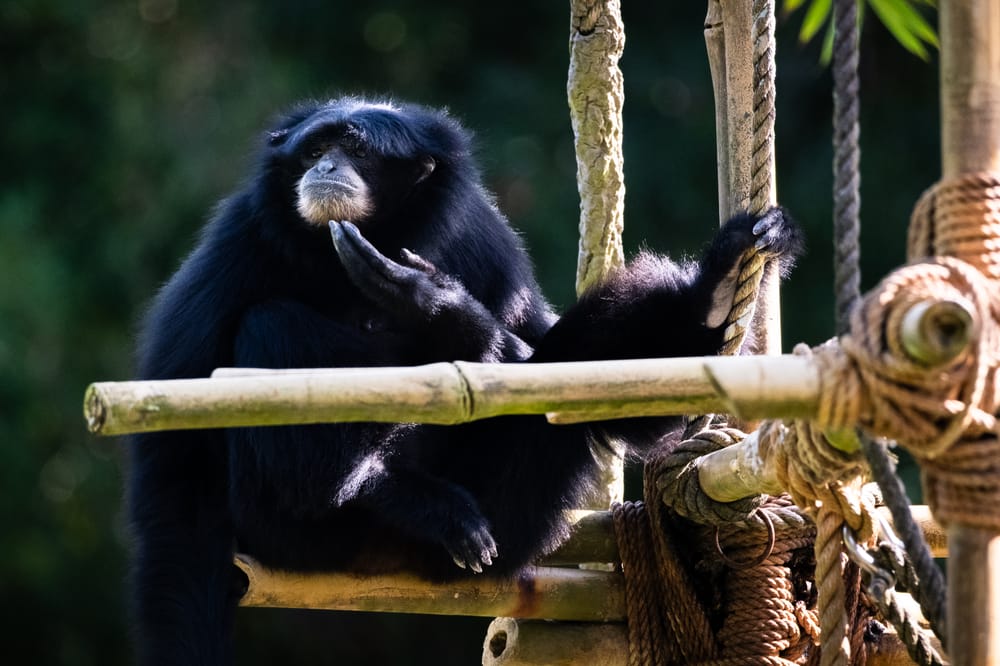
Their songs can reach up to 113 decibels, roughly equivalent to a chainsaw, and can be heard over a distance of more than 1.5 to 2 kilometers through dense rainforest canopy.
What makes this possible is their gular sac, a large throat pouch unique among gibbons. The throat sac can become as large as a grapefruit, and enables four distinct classes of vocalization: booms, barks, ululating screams, and bitonal screams.
The boom is produced by singing into the sac with the mouth closed and carries the farthest through dense forest. The "wow" is produced with the mouth open and sits at a higher pitch. Females typically produce long barks, while males generally produce bitonal screams, where two tones are produced simultaneously, creating a layered, dissonant sound, though both sexes are capable of all four types. These songs begin as deep, bell-like tones that escalate into shattering yells and culminate in high-pitched "laughter."
Their songs build social infrastructure. Mated pairs perform calling bouts lasting 10 to 20 minutes, functioning as territorial advertisement and bond reinforcement. Newly formed pairs sing more frequently than established ones, as advertising a strong bond is advantageous in territorial defense. In the wild, singing occurs roughly once every 4 to 5 days, usually in the morning but never before dawn.
Learn more from our primary sources The Wisconsin National Primate Resource Center, and The New England Primate Conservatory.
Checkout and consider supporting Kalaweit, they work to protect these incredible animals through rescue and rehabilitation of those formerly kept as pets.