S
Recent Latest #Human
Kasey in her traditional dance attire holds a Scottish flag, blowing in the wind behind her

Dec 05 2025

Kasey Hawkins: Highland Dancer & Instructor

At a talent show in Cranbrook, a city nestled in a valley on the western edge of the Rocky Mountain Trench in Canada, nine-year-old Kasey, already familiar with several dance styles, watched her friend perform a Scottish Highland dance..

Sponsored by Product on Point, leading product development studio offering innovative, tailored solutions.

In traditional Highland dress, her friend danced with an almost weightless grace, rising onto the balls of her feet and tracing clean, deliberate steps around the two practice basket-hilt broadswords crossed on the floor. Witnessing this ignited the first spark of a passion that would burn brightly in her for 20 years and counting.

I love how Highland dance combines the athleticism and power of the Scottish people.. with the grace and fluidity that comes from the influence of our Irish and French cousins (Riverdance and Ballet).

After moving to Idaho in 2014, where she taught until she relocated to Florida in 2020, Kasey and her younger siblings consistently secured top-three placements in regional and national championships. At just 18 years old, she opened her own studio, which has been the focus of her life ever since.

Over the last decade I have had the joy and honor of teaching so many amazing young people, helping them gain confidence in themselves and connect with their Scottish roots.

Kasey performs a high kick dance move

Highland dances are hundreds of years old, passed down through generations of Highlanders. Historically, dancers performed around swords before battle as a test of agility, courage, and readiness. After battle, similar dances were used in victory celebrations. Seasonal festivals and older Celtic Gaelic traditions also incorporated Highland dance at their core.

During the British military occupation of the Highlands, after the Jacobite rising of 1745, the government imposed the Act of Proscription (1746), through which Gaelic culture was stigmatized and suppressed. Highland dress, including kilts and tartan, was banned. Clans were broken up, and pipers, dance masters, and other tradition bearers lost their roles as their patronage systems collapsed.

However, by the late 18th and early 19th centuries, a cultural revival began to take shape. Sir Walter Scott a Scottish novelist, poet and historian, helped popularize a romanticized vision of the Highlands. Highland regiments in the British Army wore tartan and preserved martial dance elements, and Victorian society embraced what they saw as a picturesque Scotland.

This renewed fascination led to the formal codification of Highland dance, preserving the traditions and carrying them forward even as they evolved into forms designed for performance and competition rather than their original clan-based rituals.

Through teaching the dances to the next generation, we help keep the Celtic culture alive for many years to come.

Checkout the Hawkins School of Highland Dance's website for more.

March rounding the corner of the MOSH

Oct 20 2025

No Kings II: Jacksonville, Florida

On October 18, 2025, protesters gathered in Jacksonville as part of the No Kings II demonstrations. Here's what they were saying..

Protestors were citing Donald Trump's 34 felony convictions in New York and approximately 91 felony charges across four criminal cases as backdrop for broader concerns about executive overreach. Demonstrators argued the administration has compounded these concerns by bypassing courts, using executive power aggressively, and treating dissent as a threat.

0:00
/0:32

Protesters raised complaints about funding cuts across public institutions, pointing to the freezing of approximately $6.8 billion in K-12 funds, a hold on roughly $6 billion in university research grants across nine institutions, a proposed 26% cut to the Department of Health and Human Services budget, and proposed Medicaid reductions of $700 billion to $1 trillion over ten years. On immigration, demonstrators cited evidence of wrongful deportations and full-body restraints on nonviolent detainees, over 510 credible abuse allegations involving pregnant women and children, and an expansion of mass raids at farms, hotels, and restaurants.

Protesters outside the MOSH
The Protest started at the MOSH (Museum of Science & History), then crossed the Main Street Bridge

Marchers also alleged suppression of free speech despite the administration's executive order titled "Restoring Freedom of Speech and Ending Federal Censorship," pointing to the revocation of visas for foreign nationals who posted political criticism online, FCC proceedings opened against media outlets at the administration's request, and the removal of federal web pages covering diversity, environmental protection, and gender identity. On economic policy, demonstrators cited the 2017 tax cuts as favoring top earners, a "gold-card" residency program allowing wealthy foreigners to purchase U.S. residency, and tariff policies they argued burden lower-income households most heavily.

Main Street Bridge march
Marching across the Main Street Bridge

Underlying all of these complaints was a concern about democratic backsliding. Protesters pointed to directives requiring independent agencies to submit regulations for White House review, public attacks on judges who ruled against the administration, replacement of career federal officials with political loyalists, and analyst warnings that U.S. actions are sending signals abroad that embolden authoritarian governments. The administration has disputed many of these characterizations, framing budget cuts as fiscal responsibility, immigration enforcement as upholding existing law, and agency restructuring as modernization rather than politicization.

Actor portraying a woman in American colonial times

Oct 03 2025

Women of Colonial Florida: Shaping Early Society

In textbooks, colonial women are usually cast in the background: daughters of settlers, wives of soldiers, or mothers of many. But they were also merchants, midwives, translators, teachers, and survivalists.

Captured in the Colonial Quarter of St. Augustine, Florida, the nation's oldest city, this image depicts a historical reenactment of women's lives during the colonial era.

The often overlooked lives of women during these times shaped early colonial society through care, resilience, and unrecorded labor.

Women in 18th-century St. Augustine managed households that doubled as inns, marketplaces, and informal clinics.

They raised children under shifting flags, from Spanish to British and back again, navigating new languages, laws, and expectations with every change in rule.

Many kept small farms, tended animals, and preserved family lineages during times when their husbands were away fighting, trading, or lost to war.

Clothing as Language

In this article's image, the linen chemise and bonnet signal modesty and function, while the straw hat and vibrant overdress suggest European influence and social adaptability.

Clothing was both practical and political, a way to assert identity, status, and even resistance.

In a city that housed enslaved Africans, free Black tradespeople, Spanish settlers, British officers, and indigenous allies, women’s dress served as a visual shorthand for loyalty, class, religion, and occupation.

Less Visible but Essential

Though few left written records, colonial women played a central role in shaping life in St. Augustine. They taught language and tradition across generations, brokered peace within households, and carried memory forward.

Enslaved and indigenous women, in particular, preserved foodways, healing practices, and oral histories that helped entire communities survive.

Women during this period were the threads in the city's complex colonial fabric.

Learn more at the Colonial Quarter of St. Augustine's official site.

Rock Climbing: The Neuroscience of Why We Climb

Sep 03 2025

Rock Climbing: The Neuroscience of Why We Climb

Rock climbing is a mental game fueled by our most powerful brain chemicals that make the experience exhilarating, even addictive, despite the fears involved.

Sponsored by Gimme Sourdough, made-to-order breads and bagels in Wheatridge, CO

Climbing combines intensity, presence, and purpose. When climbing, you're fully immersed physically, mentally, and emotionally. The brain interprets this complex stimulation as meaningful, which can provide deep satisfaction.

Unlike many forms of exercise, climbing requires problem-solving and risk management, which heightens engagement and rewards your brain even further.

Every climb floods your system with the following cocktail of neurotransmitters that boost mood, focus, and connection.

Climber 30-40ft up at Floyd Hill, Colorado.

Dopamine: The Reward

Dopamine is released when we anticipate and accomplish a goal, such as sending a tough route or reaching the summit. It fuels motivation, creates a sense of pleasure, and drives climbers to keep pushing past their limits. Each successful hold or completed climb gives a rewarding dopamine hit that reinforces the behavior.

Adrenaline: The Rush

Climbers often encounter fear and risk, which triggers a surge of adrenaline. This fight-or-flight hormone heightens your senses, increases energy, and sharpens focus. It's what makes your heart race as you hang 30 feet up and makes you feel so alive.

Endorphins: The Painkiller

Rock climbing is physically demanding and occasionally painful. Endorphins are the brain’s natural opioids. They are released during sustained exertion and discomfort, helping reduce pain and induce a euphoric feeling often referred to as the “climber’s high.”

Serotonin: The Mood Stabilizer

Climbing outdoors, especially on real rock, boosts serotonin levels. Serotonin is linked to sunlight exposure, aerobic activity, and mood stability. The combination of nature, movement, and challenge improves well-being and combats anxiety and depression.

Oxytocin: The Bonder

Whether you're climbing indoors or outside, the sport involves trust, as when your partner is belaying (responsible for your rope), spotting, or cheering you on, these interactions release oxytocin, the social bonding hormone, which fosters emotional closeness and community.

HandsOff Protest St. Augustine

Apr 08 2025

HandsOff Protest: Saint Augustine, Florida

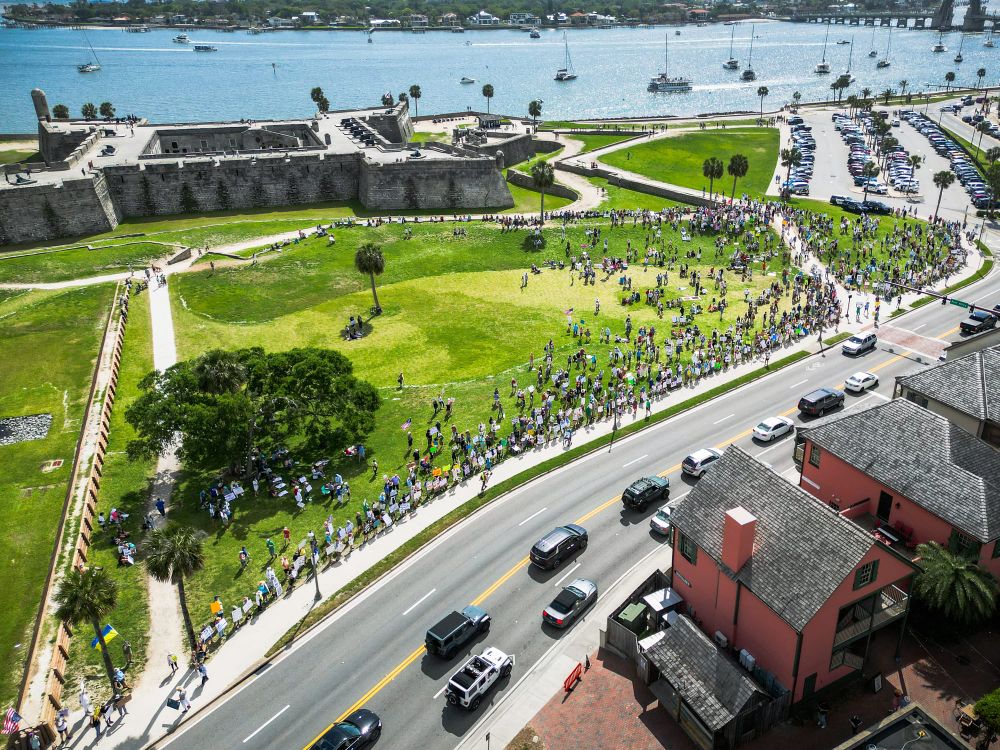
Hundreds gathered at the Castillo de San Marcos National Monument to protest the "Billionaire Takeover," addressing the Trump administration's policies that disproportionately favor wealthy individuals and specifically highlighting Elon Musk's role in government restructuring.

The "Hands Off!" protests, initiated on April 5, 2025, represented a significant nationwide mobilization against policies enacted by President Donald Trump and his administration. Organized by a coalition of over 150 groups, the movement drew millions of Americans across over 1,400 locations nationwide, spanning all 50 states.

Left's Arguments

  • Mass Layoffs and Agency Closures: Under Musk's and the Department of Government Efficiency (DOGE), approximately 216,000 federal jobs were terminated across major departments. Raising concerns about the dismantling of essential public services. ​(Business Insider)
  • Conflicts of Interest and Private Enterprises: House Democrats initiated an investigation into potential conflicts of interest involving Musk and NASA. Concerns centered on Musk's dual role within the federal government and his business ties through SpaceX, which secured over $15 billion in NASA funding. (Axios)
  • Use of AI for Surveillance: DOGE employed AI to monitor federal agencies for sentiments perceived as hostile to the administration's policies. (Reuters)

Right's Arguments

  • Efficiency and Cost Savings: Musk's initiatives aimed to eliminate wasteful government spending. DOGE claimed to have achieved significant budgetary savings by terminating over 16,000 grants and contracts (Business Insider)
  • Government Modernization: The administration posited that restructuring efforts were designed to modernize government operations, making them more efficient and responsive. Musk emphasized the need to "weed out corruption" and implement systems to enforce accountability. (Dallas Weekly)

Assessment

While the administration's objectives centered on efficiency and modernization, the methods employed (large-scale layoffs, potential conflicts of interest, and surveillance practices) raised concerns about transparency, democratic integrity, and the equitable distribution of power. 

The evidence suggests that the protesters' apprehensions regarding the consolidation of influence among wealthy individuals and the potential undermining of democratic institutions were well-founded. 

Therefore, the arguments presented by the protesters appear to be more substantiated when considering the available data.​ (GeoPolicalEconomy, Brookings, FedScoop, Time, NPR, PBS)

Flagler College: Gilded Age Ceiling

Dec 04 2024

Flagler College: Gilded Age Ceiling

Nestled in St. Augustine, Florida, Flagler College was originally built as a luxury hotel by industrialist Henry Flagler in 1888, now it's a National Historic Landmark, and a testament to the grandeur of the Gilded Age.

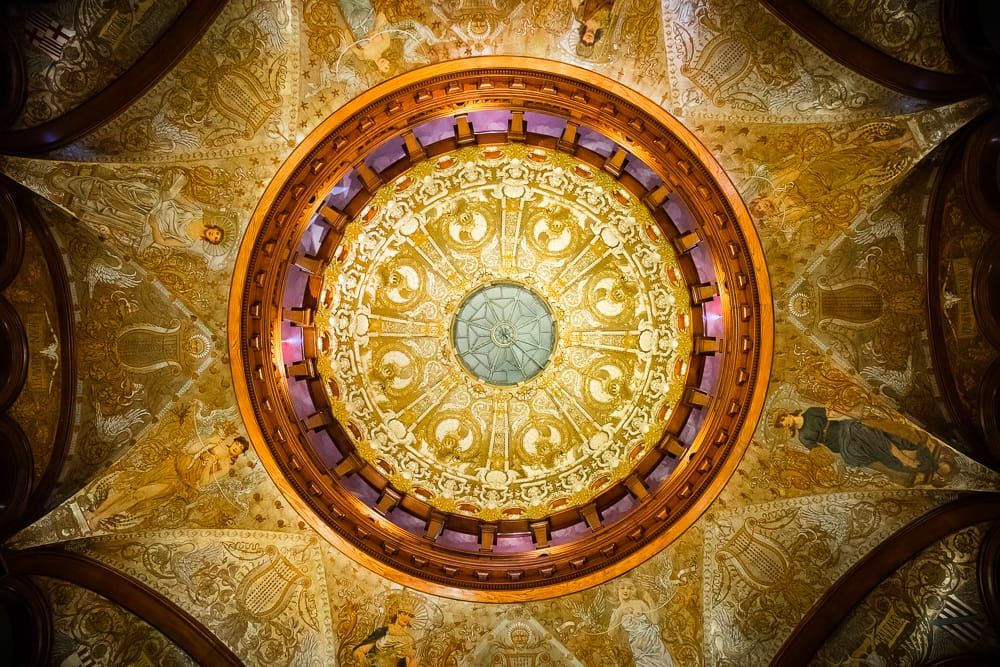
The ceiling of the grand rotunda in Ponce de León Hall is a dazzling display of artistic brilliance. Designed by Louis Comfort Tiffany, a celebrated artist and glassmaker, the ceiling features intricate patterns of gold leaf, stained glass, and hand-painted murals. Tiffany is known for his innovative use of light and color.

At the center of the ceiling is an elegant stained-glass dome, which allows natural light to filter through, illuminating the golden accents and vibrant hues of the surrounding designs. The dome is framed by intricate woodwork, enhancing its visual appeal and creating a sense of depth and majesty.

Symbolism in Every Detail

The ceiling’s ornate decoration is not just visually stunning but also rich in symbolism. Surrounding the dome are painted panels depicting figures that represent the arts, sciences, and humanities, reflecting the intellectual and cultural aspirations of the Gilded Age. Musical instruments, floral motifs, and mythological themes are woven into the design, emphasizing the building’s dual role as a place of luxury and enlightenment.

A Legacy of Innovation

The Ponce de León Hotel, now Flagler College, was one of the first buildings in the United States to be constructed with poured concrete and equipped with electricity. The combination of cutting-edge technology and Tiffany’s artistic vision made the ceiling a marvel of its time. The integration of natural light and gilded embellishments created a space that was both functional and awe-inspiring.

Learn more at the Flagler College website.

View Recent Posts

Explore More